

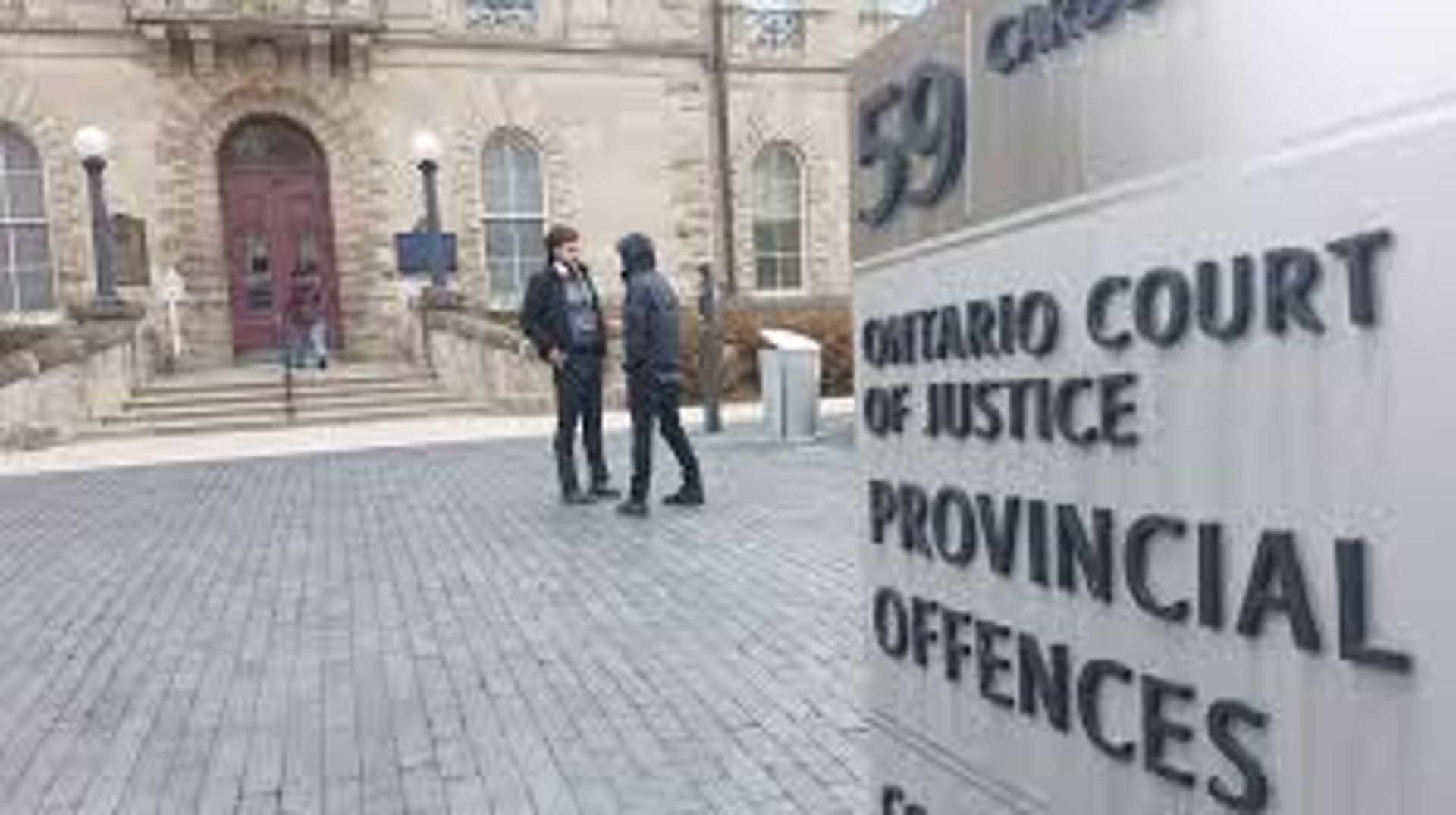
PROVINCIAL OFFENCES COURT
Provincial Offences Court is where non criminal matters are heard.
There are many laws where individuals and organizations are charged that are heard in the Provincial Offences Court.
Depending on the severity of the charge and law you are or your organization are charged under, accused parties may face up to two years in prison. However, most laws provide a maximum penalty for a term of imprisonment to be no more than six months.
Never assume that the charge does not call for imprisonment, or it is not that serious.
Always et legal advice!
The following are some laws where charges are heard within the Provincial Offences Court.
Each law is linked to a section below, which will provide a brief description of the law, some possible charges, and penalties.
Highway Traffic Act
Compulsory Automobile Insurance Act
Workplace Safety and Insurance Act
Occupational Health and Safety Act
Employment Standards Act
Tobacco Tax Act
Highway Traffic Act
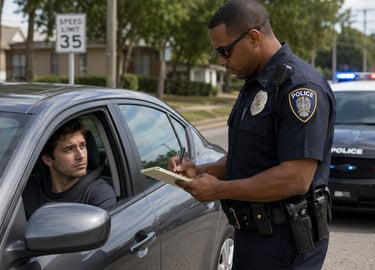
There are over 200 sections of the highway traffic act where an individual and/or an organization can be charged and possibly found guilty for.
Click here to view a copy of the Highway Traffic Act
In addition to fines, and/or imprisonment, a party can also face demerit points on their driver’s license.
Individuals and organization will also see a significant increase in their vehicle insurance premiums.
Never assume a charge is minor until you have sought legal advice!
Demerit Points to Fully Licenced Drivers
If you obtain 6 to 8 demerit points you will be sent a warning letter. At 9 to 14 points you will be sent a second warning letter. If you obtain 15 or more demerit points your license will be suspended for 30 days. After the suspension period you may need to take the vision, written, and road tests again. After which your license will be reinstated with 7 demerit points.
Demerit Points to Novice Drivers
A novice driver is a driver who holds a G1, G2, M1, M2, M1-L or M2-L licence.
If you have obtained 2 to 5 demerit points you will receive a warning letter.
If you have obtained 6 to 8 demerit points you will receive a second warning letter. if you obtain 9 demerit points or more your license will be suspended for 60 days.
Escalating Penalties:
-convicted of breaking graduated licensing rules
-convicted of a Highway Traffic Act offence that results in four or more demerit points (e.g., street racing, careless driving)
-subject to a court-ordered suspension for a Highway Traffic Act offence that would have otherwise resulted in four or more demerit points
7 Demerit Points:
-failing to remain at the scene of a collision
-failing to stop when signaled or asked by a police officer
6 Demerit Points:
-careless driving
-racing
-exceeding the speed limit by 40 km/h or more on roads with a speed limit of less than 80 km/h
-exceeding the speed limit by 50 km/h or more
-failing to stop for a school bus
5 Demerit Points:
-failing to stop at an unprotected railway crossing (for bus drivers only)
4 Demerit Points:
-exceeding the speed limit by 30 to 49 km/h
-following too closely
-failing to stop at a pedestrian crossover
3 Demerit Points:
-driving while holding or using a hand-held wireless communications or entertainment device
-driving while viewing a display screen unrelated to the driving task
-exceeding the speed limit by 16 to 29 km/h
-driving through, around or under a railway crossing barrier
-driving the wrong way on a divided road
-driving or operating a vehicle on a closed road
-failing to yield the right-of-way
-failing to obey a stop sign, traffic control stop/slow sign, traffic light or railway crossing signal
-failing to obey the directions of a police officer
-failing to report a collision to a police officer
-failing to slow and carefully pass a stopped emergency vehicle or a tow truck with its amber lights flashing
-failing to move, where possible, into another lane when passing a stopped emergency vehicle or a tow truck with its amber lights flashing
-improper passing
-improper driving when road is divided into lanes
-going the wrong way on a one-way road
-crossing a divided road where no proper crossing is provided
-crowding the driver’s seat
-driving a vehicle equipped with a radar detector
-improper use of a high-occupancy vehicle (HOV) lane
2 Demerit Points:
-improper right turn
-improper left turn
-improper opening of a vehicle door
-prohibited turns
-towing people — on toboggans, bicycles, skis
-unnecessary slow driving
-backing on highway
-failing to lower headlamp beams
-failing to obey signs
-failing to stop at a pedestrian crossing
-failing to share the road
-failing to signal
-driver failing to wear a seat belt
-driver failing to ensure infant/ child passenger is properly secured in an appropriate child restraint system or booster seat
-driver failing to ensure that a passenger less than 23 kg is properly secured
-driver failing to ensure that a passenger under 16 years is wearing a seat belt
-driver failing to ensure that a passenger under 16 years is sitting in a seat that has a seatbelt
Workplace Safety and Insurance Act
The Workplace Safety and Insurance Act is the law that replaced the former Workers Compensation Act. It provides enforcement process, which the Workplace Safety and Insurance Board has to enforce the law. This is something unique that was never previously included in prior workers compensation laws.
Click here to view the Workplace Safety and Insurance Act.
The WSIB has a conviction webpage that provides the individual who has been convicted and the penalty they faced.
Click here to view the WSIB conviction webpage.
The WSIB and its respective law the WSIA have different penalties for each party,
whether they are an injured worker or whether they are the accident employer.
Employer Penalties
There are also penalties to employers for also giving a misleading or false statement, intentionally causing a claim to be suppressed, failing to report a workplace accident, and others.
Injured Worker Penalties
A worker who is in receipt of workers compensation benefits from the WSIB can be charged under a. 149 (1) where a person who knowingly makes a false or misleading statement to the WSIB, or (2) where a worker willfully fails to inform the Board of a material change in circumstance in connection with his or her entitlement to benefits within 10 days after the change occurs.
In reviewing the convictions of injured workers many receive substantial fines of $5,000 to $10,000 and in some cases some receive up to a year of imprisonment.